

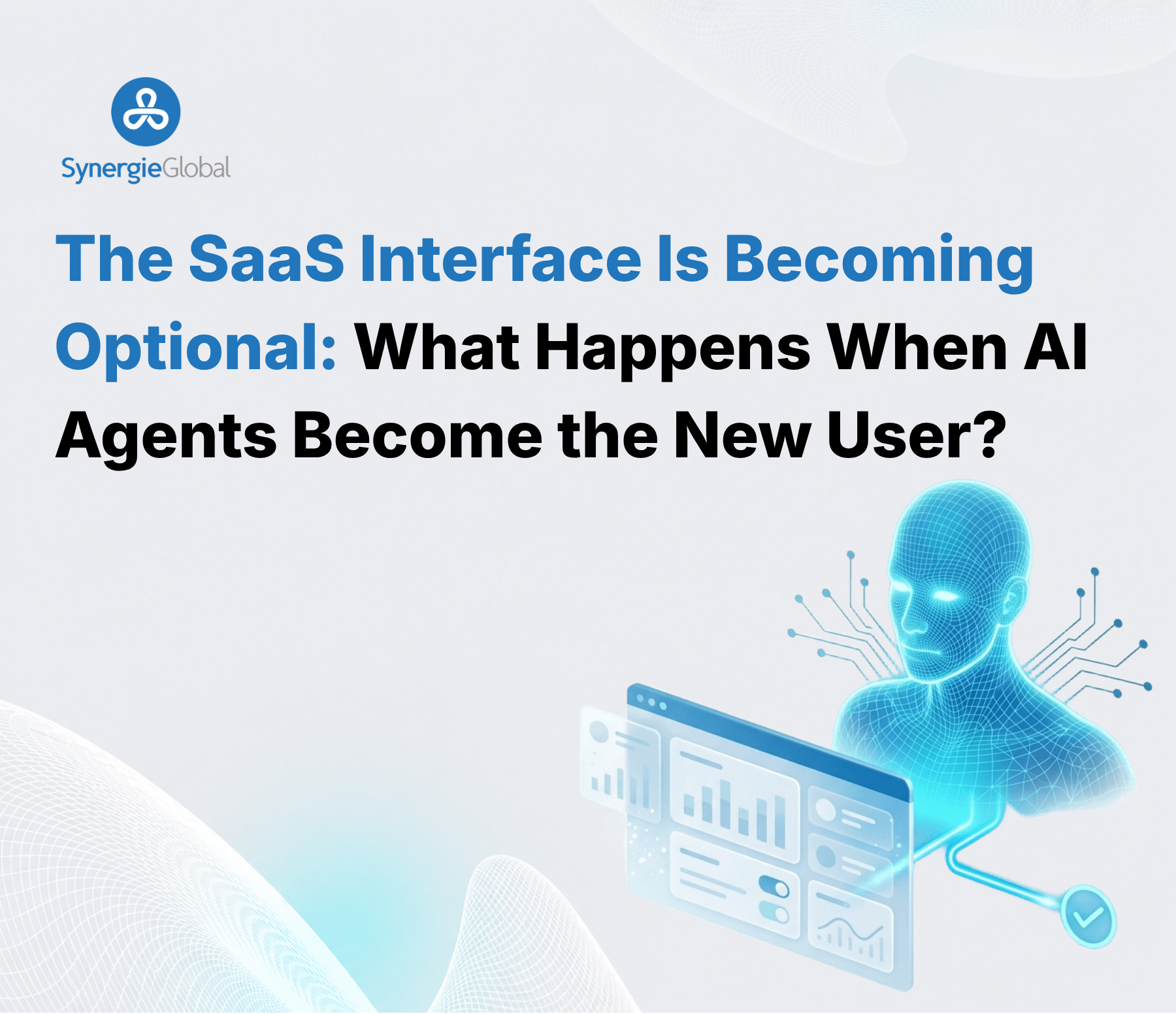
For decades, enterprise software was built around one assumption: a human will use it.
That assumption shaped everything, screens, dashboards, workflows, permissions, and even how software was priced.
Agentic AI introduces a different possibility: what if the primary consumer of software is increasingly an AI agent acting on behalf of a human?
The shift looks simple:
Today: Human → Interface → Application → Action
Emerging: Human → AI Agent → Applications → Action → Business Outcome
The interface may become less important to how enterprise software actually creates value.
From Applications to Capabilities
This does not mean SaaS disappears. It means the role of the application may change.
Instead of employees manually navigating multiple systems, agents could increasingly access data, trigger workflows, move information between applications, and execute tasks across the software stack.
That makes capabilities more important than interfaces.
Can the agent access the system?
Can it understand the data and available functions?
Can it act safely within defined permissions?
And can that action produce a measurable business outcome?
These questions may become increasingly important when evaluating enterprise software.
The $234B Signal
The potential scale of this shift is already significant. Industry projections suggest that up to $234 billion in enterprise application software spending could be exposed to “agentic arbitrage” by 2030.
But the important question is not whether $234 billion simply disappears from SaaS.
It is where the value moves when agents become the ones interacting with software.
If employees spend less time inside applications, software value may shift away from the interface and toward what sits underneath it: accessible data, integrations, execution capabilities, security, permissions, and reliable outcomes.
What Should Technology Leaders Rethink?
For CTOs and CIOs, this creates a different way to evaluate the enterprise software stack.
Instead of asking only:
“What does this application offer our employees?”
The question increasingly becomes:
“What can an AI agent do with it?”
That could influence architecture, procurement, integration strategy, licensing, and governance.
The next generation of enterprise technology may not require less software.
It may require software designed to work for both humans and the agents acting on their behalf.
The real shift may not be the end of SaaS.
It may be the moment when the interface stops being the most important part of the software.