
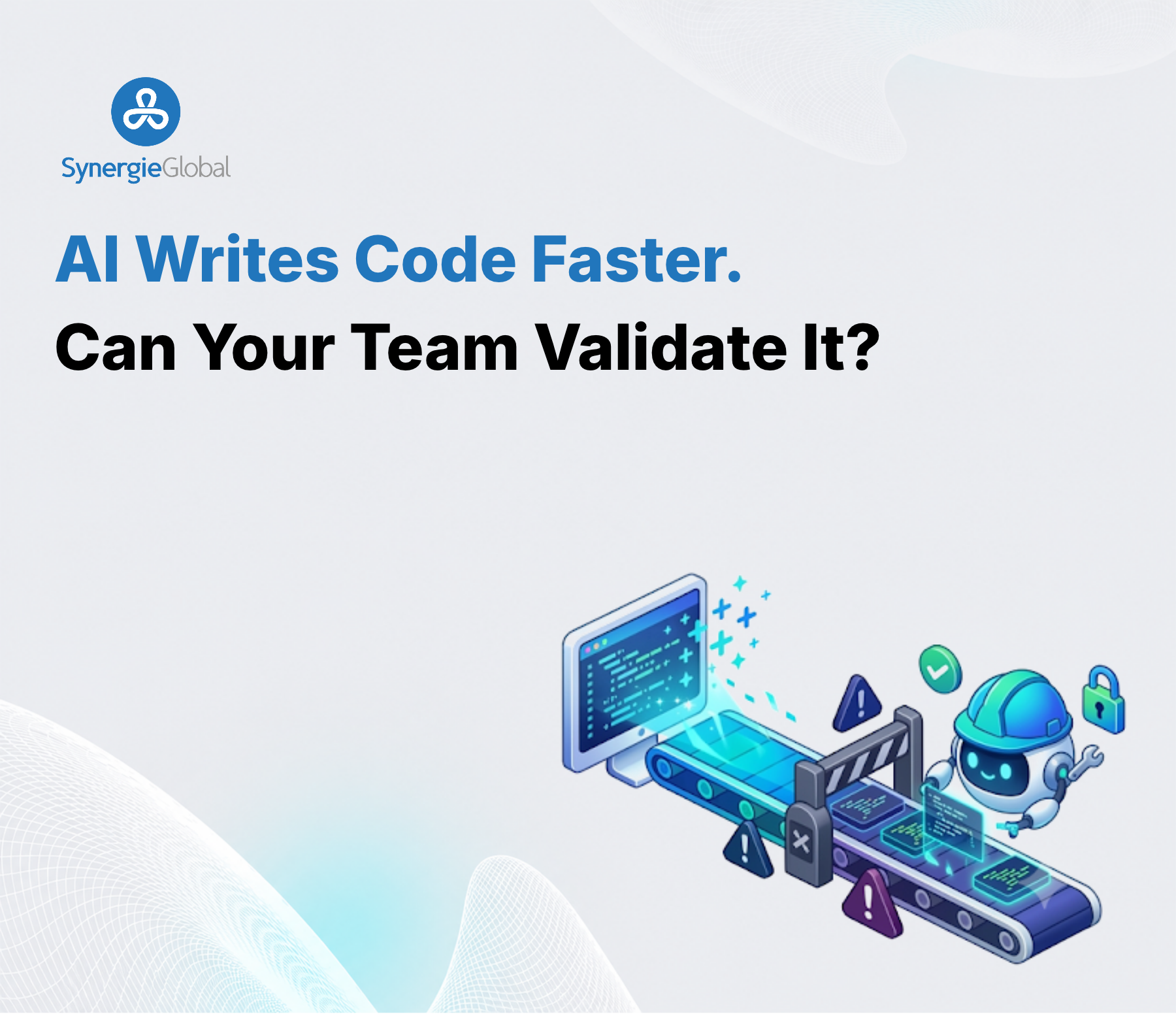
YCoding agents can now implement changes across a codebase and open pull requests with less direct developer involvement. But can your engineering process validate those changes just as quickly?
As agents take on more implementation work, code production may accelerate while review, testing, security checks, and integration remain constrained by existing workflows and team capacity.
Software delivery is not complete when code is generated. Every change still needs to be evaluated against functional requirements, architectural standards, security controls, and production expectations.
When implementation scales faster than validation, the delivery pipeline risks accumulating changes that are waiting to be reviewed, tested, or approved.
The challenge for CTOs is no longer just accelerating code production. It is building the capacity to validate agent-generated changes without sacrificing quality, security, or delivery stability.
Why Faster Coding Doesn’t Guarantee Faster Delivery
Agentic coding is changing how software moves from an idea to a pull request. Coding agents can implement features, modify multiple files, generate tests, and submit changes for review. AI can also help review code produced by other AI systems.
These capabilities can increase the pace of implementation, but they do not automatically ensure that changes are correct, secure, or compatible with the wider system.
Industry research has highlighted an important distinction: AI adoption can be associated with improvements in delivery throughput while delivery stability remains a challenge. Faster movement through the pipeline does not necessarily translate into more reliable software.
For CTOs, the question is whether review, testing, security, and architecture controls can keep pace with the volume and complexity of agent-generated changes.
As coding agents take on more implementation work, validation must evolve from a series of manual checkpoints into a continuous, risk-based system of controls.
1. Code Review: More Pull Requests, More Cognitive Load
Agent-generated code still requires engineering judgment.
Reviewers must understand what changed, why it changed, whether the implementation fits the existing codebase, and whether it introduces unexpected behavior. As agents produce more pull requests, experienced engineers can become a shared bottleneck.
AI-based code review can help identify potential defects, flag suspicious patterns, and summarize changes before a human reviewer gets involved. But an AI reviewer can also miss contextual issues or fail to recognize flaws in the implementation’s underlying assumptions.
The answer is not to review every change with the same depth—or to assume that one AI system can reliably validate another.
Instead, establish review requirements based on risk. Small, isolated changes with strong automated coverage may qualify for a lighter review process. Changes affecting authentication, critical business logic, data integrity, or shared architecture should receive deeper scrutiny and clearly assigned ownership.
The objective is to use automation to reduce routine review effort while preserving engineering judgment where it matters most.
2. Testing and QA: Automate Feedback, Not Accountability
Testing can become a constraint when implementation moves faster than verification.
If coding agents produce changes faster than the organization can run regression tests, investigate failures, or validate integrations, the time saved during implementation can disappear before release.
CTOs should strengthen automated feedback loops across unit, integration, regression, and end-to-end testing. Continuous integration should detect failures early, while test coverage should reflect system behavior and risk—not simply the number of tests generated.
Agents can also help create and maintain tests. However, generated tests require independent validation. A test that reflects the same assumptions as the implementation may pass without detecting the underlying defect.
Teams should therefore assess whether tests cover expected behavior, edge cases, failure conditions, and relevant system interactions.
The goal is faster, more reliable feedback—not automation for its own sake.
3. Security Validation: Make Risk Visible Before Release
Agent-generated changes can introduce vulnerabilities, unsafe dependencies, exposed secrets, or unintended data access. Coding agents may also have permissions to read files, modify code, or interact with development tools, making their operating boundaries an important part of the security model.
Security controls should be integrated into the development pipeline rather than left until the end of the release process.
Automated static analysis, dependency scanning, secret detection, and policy checks can identify many issues early. Agent permissions should follow the principle of least privilege, limiting access to what is necessary for the task. Higher-risk changes should trigger additional security review and testing.
Automation can detect known patterns and enforce defined policies, but it cannot replace every form of security judgment.
CTOs should define which findings block a release, which require remediation within an agreed timeframe, and which require explicit risk acceptance.
4. Architecture and Integration: Protect System-Level Quality
A code change can pass its individual tests and still create problems for the wider system.
An agent may follow local instructions without fully accounting for architectural constraints, service boundaries, backward compatibility, or downstream dependencies. The result may appear correct in isolation while creating integration problems elsewhere.
Engineering leaders should establish clear design standards, ownership boundaries, and escalation paths for changes that affect shared services or critical interfaces. Contract testing and integration testing can help identify incompatibilities before they reach production.
Agents should also operate with sufficient architectural context and clearly defined boundaries around the systems they can modify.
AI can accelerate implementation, but architectural coherence remains an organizational responsibility.
How CTOs Should Redesign the Delivery Pipeline
The first step is not to add more reviewers or immediately invest in another testing tool. It is to identify where delivery is actually constrained.
Step 1: Measure where work waits. Track the time from pull-request submission to first review, review completion, test completion, and deployment. Separate queue time from active work time. Long waits can reveal capacity or workflow problems that coding-speed metrics miss.
Step 2: Segment changes by risk. Define validation requirements according to security impact, architectural scope, data sensitivity, and business criticality. Apply deeper checks where the consequences of failure are highest.
Step 3: Automate repeatable checks. Prioritize reliable automated tests, continuous integration, security scanning, and deployment controls. Use AI review to support triage and identify potential issues, while retaining appropriate human oversight for contextual judgment and high-impact decisions.
Step 4: Assign clear ownership. Every change should have a defined owner, appropriate approval requirements, and an escalation path when validation fails. Agent-generated code should never create ambiguity about who is accountable for quality and release decisions.
Step 5: Measure delivery outcomes, not code volume. Monitor lead time, review delays, change failure rate, escaped defects, rework, and production stability alongside agent adoption. These metrics help determine whether coding agents are improving the end-to-end delivery system or merely increasing output at one stage.
The Competitive Advantage Is End-to-End Engineering
Agentic coding creates an opportunity to increase engineering throughput, but organizations will capture that opportunity only when validation, integration, security, and architectural governance can keep pace.
The answer is not to slow every change down or to trust every generated pull request. It is to redesign the delivery pipeline so routine changes receive fast, automated feedback while high-risk changes receive the scrutiny they require.
For CTOs, the most useful question is no longer simply, “How much faster can our engineers write code with AI?”
It is:
“Can our organization turn agent-generated changes into reliable, secure, production-ready software without creating a growing backlog of unvalidated work?”
The teams that solve this challenge will be better positioned to translate agentic coding into sustained engineering performance.
Because the real measure of AI productivity is not how much code an organization can generate. It is how much reliable software it can safely deliver.