

It’s 2 a.m. and an engineer is debugging a production failure. The root cause feels familiar, and it should: the team fixed a nearly identical incident eight months ago. But the fix lives in a closed ticket, the reasoning in a pull request thread, and the trade-off in a design discussion nobody can find.
So the investigation starts from zero.
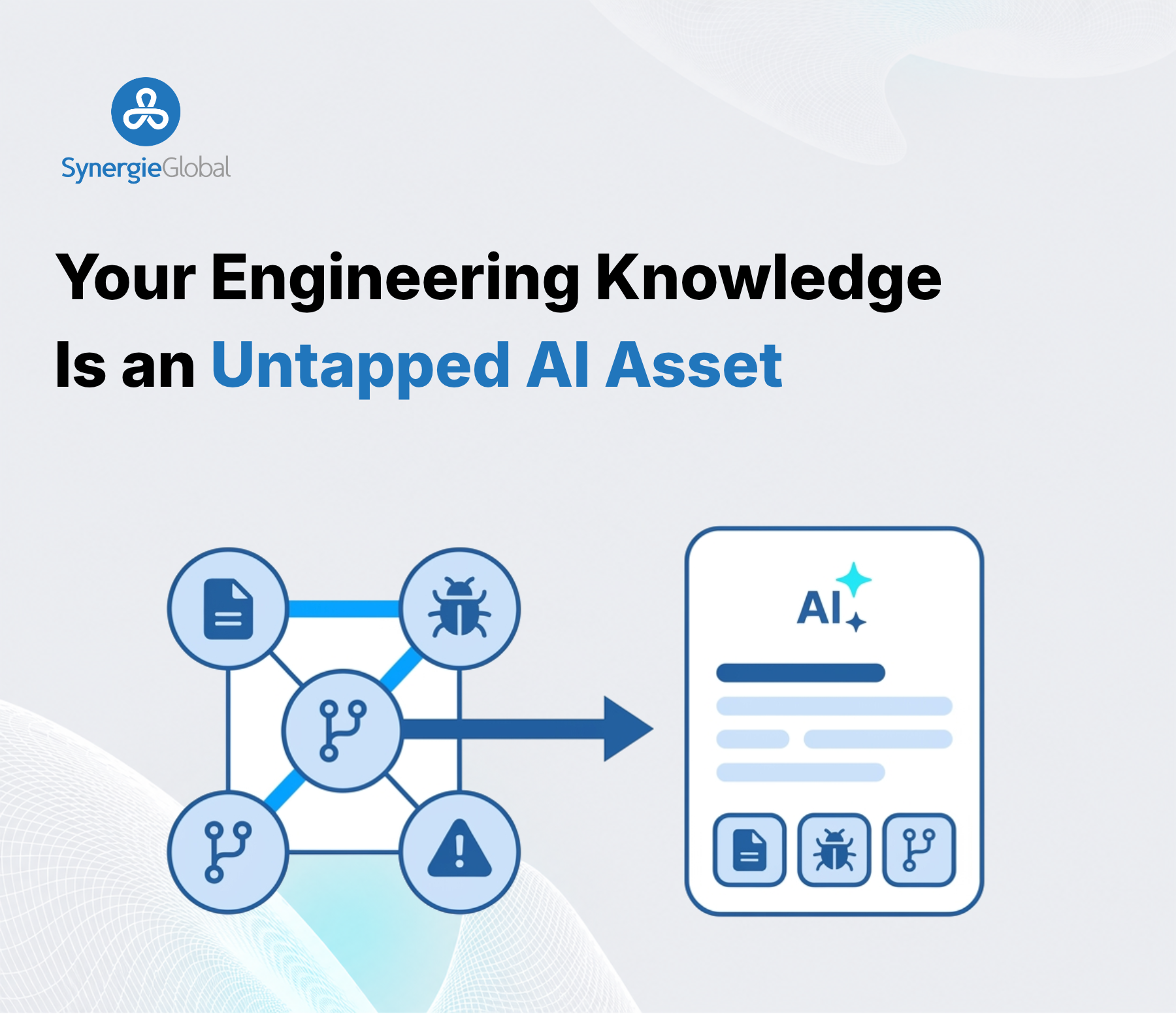
Engineering teams produce valuable knowledge every day. The challenge is that it stays scattered across repositories, documentation, project tools, and conversations, and AI can’t use what it can’t connect.
1. Why Document Search Isn’t Enough for Engineering
Many teams start by embedding their documents and enabling retrieval-augmented generation (RAG). That helps, but engineering knowledge doesn’t live in individual documents. A retrieved page rarely tells you which code change implemented a decision, or which incident triggered it.
Engineering knowledge is relational: its value sits in the links between pieces of information, not only in the pieces themselves.
2. Three Layers of Engineering Knowledge to Connect
- Codebase layer: commits, pull requests, dependencies, and technical debt show how the system evolved.
- Design layer: architecture decision records, trade-off discussions, and implementation notes show why it evolved that way.
- Operations layer: incidents, debugging histories, and root cause analyses show how the system behaves under real conditions.
Each layer is useful alone. Linked together, they let an engineer or an AI trace a failure back to the change that caused it and the decision behind that change.
3. Building a Connected Engineering Knowledge Layer
A practical architecture can use five components:
- Ingestion: pull from code repositories, issue trackers, documentation, CI/CD systems, and incident platforms.
- Normalization: standardize identifiers, timestamps, ownership, and component names so records can be matched across tools.
- Relationship mapping: link code changes, design decisions, incidents, and outcomes. A knowledge graph can help, but it isn’t mandatory. Match the architecture to the complexity of your problem.
- Hybrid retrieval: combine semantic search with structured queries and relationship-based lookups, so answers arrive with their surrounding context.
- Access and verification: respect permissions and keep a link to the original source, so every AI answer can be checked against real evidence.
4. A Practical Roadmap to Get Started
You don’t need to connect every system at once.
- Pick one recurring, high-value problem, such as production incident investigation.
- List the sources engineers consult when solving it.
- Link incidents to the code changes, components, and earlier decisions involved.
- Agree on consistent metadata and clear source ownership.
- Add AI-assisted retrieval that shows its evidence.
- Review results with engineers and set a routine for retiring outdated entries.
- Track practical outcomes: investigation time, repeat incidents, knowledge reuse, and onboarding speed.
5. Start With the Problem Your Team Keeps Solving Twice
The aim isn’t another documentation repository. It’s to make sure the next engineer, or the next AI assistant, starts from what the team already worked out instead of from scratch.
Start with the incident your team keeps investigating twice. Connect what surrounds it, and you have a working template to expand across your engineering systems.