

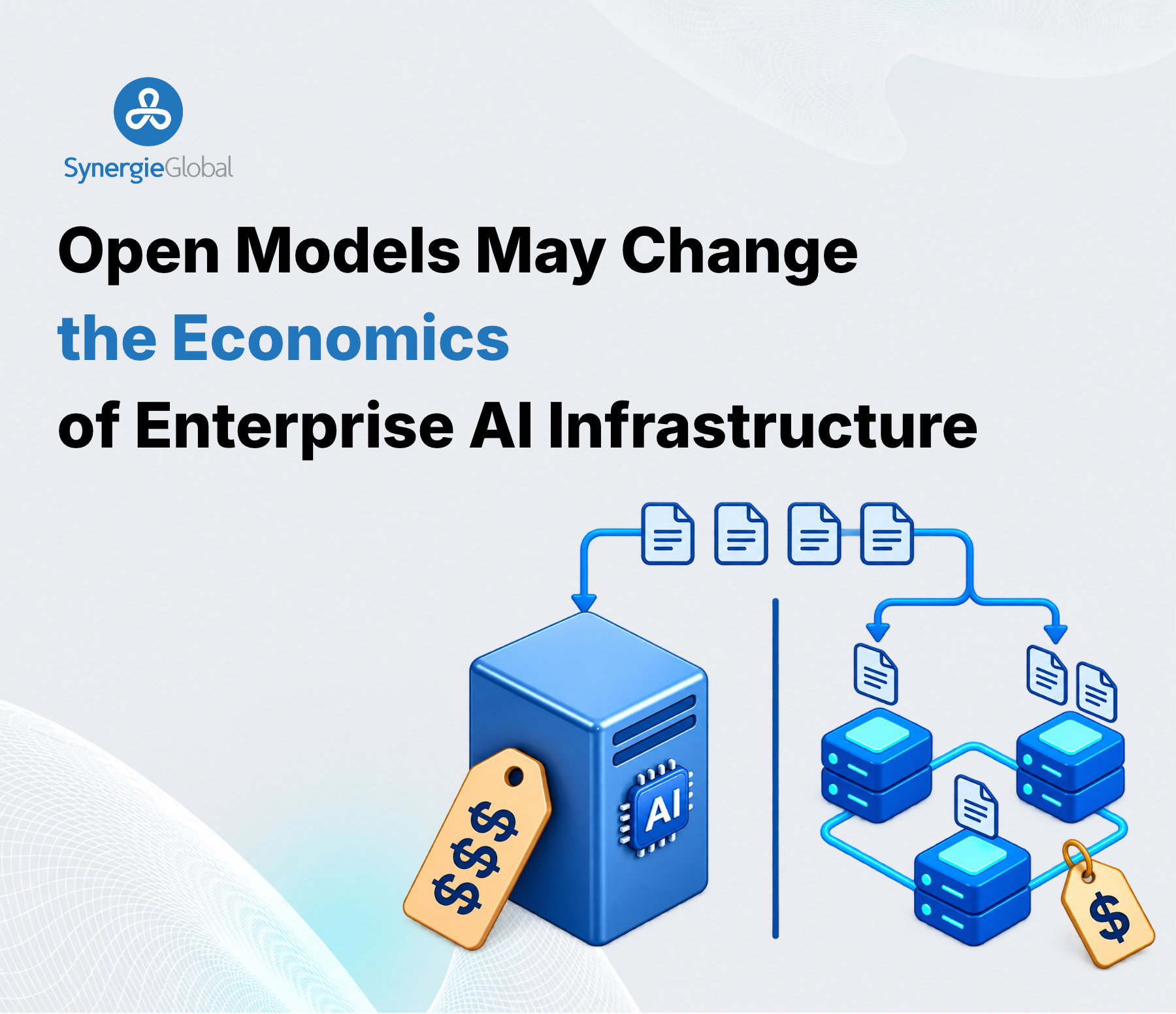
Choosing an AI model is often treated as the first major infrastructure decision. Organizations compare capabilities, benchmark performance, and evaluate API pricing before selecting a provider.
But as enterprises move from isolated AI applications to multi-step agentic workflows, model pricing tells only part of the story.
An agent may call a model repeatedly to plan, retrieve information, use tools, validate results, and recover from errors. Each step introduces decisions about context, routing, compute, and infrastructure.
The real question is no longer just which model costs less. It is how to design the system that runs it economically.
1. Understand the Full Cost of AI Inference
The cost of an AI workload extends beyond input and output tokens. It can include:
- Repeated processing of shared context across agent steps.
- Multiple model calls for planning, execution, and validation.
- Infrastructure and GPU utilization.
- Latency and throughput requirements.
- Engineering, monitoring, and maintenance overhead.
This makes cost per completed task or workflow a more useful measure than model pricing alone.
IBM Research offers an interesting example in its chip-design experiment. Its open-model configuration reportedly completed a 100-hypothesis search for approximately $26 in inference costs, compared with $299 for an all-proprietary configuration. However, the proprietary configuration achieved a higher reported speedup. The result illustrates a cost–performance trade-off, not a universal advantage for open models.
2. Four Decisions That Shape an Economical Inference Architecture
Match Models to Workloads
Not every task requires a frontier model. Classification, extraction, and straightforward tool calls may be handled by smaller models, while complex reasoning or high-impact decisions may justify more capable systems.
Workload-based routing can help balance capability, cost, and latency. However, routing overhead, retries, and output quality must also be measured.
Reduce Repeated Context Processing
Agentic workflows often reuse instructions, reference material, and shared context. Prompt caching can reduce redundant processing when the platform and request patterns support it.
The objective is not simply to shorten prompts. It is to identify what can be reused safely without sacrificing relevant or current information.
Evaluate Open-Weight and Proprietary Deployment
Proprietary APIs can simplify deployment and provide access to advanced capabilities without managing serving infrastructure.
Open-weight models offer more control over deployment, customization, and infrastructure choices. But self-hosting introduces GPU costs, capacity planning, scaling, maintenance, and operational responsibility.
The right comparison is total cost of ownership—not model access price alone.
Distribute Inference Where It Makes Sense
Distributed inference can help serve large models and demanding workloads across available compute resources. Techniques such as separating prompt processing from token generation and routing requests based on cache availability can improve resource utilization.
But distribution also introduces networking, orchestration, and operational complexity. Its value depends on workload volume, latency requirements, model size, and available infrastructure.
3. A Practical Decision Framework for CTOs
Before changing models or infrastructure, organizations should:
- Map agent workflows and measure their inference patterns.
- Establish baseline cost per completed task.
- Classify tasks by complexity, accuracy, volume, and latency.
- Identify repeated context and caching opportunities.
- Pilot alternative routing and deployment strategies.
- Compare total operating costs, reliability, and performance.
- Scale only approaches that demonstrate measurable improvements.
Conclusion: Optimize the System, Not Just the Model
Open models, caching, workload routing, and distributed inference are not competing shortcuts. They are architectural choices that can work together—or introduce unnecessary complexity when applied without a clear workload requirement.
For enterprise leaders, the goal is not to find the cheapest model. It is to build an inference system that delivers the required outcomes at an acceptable cost, with the performance, reliability, and control the business needs.
A more economical AI system begins with better architecture decisions, not simply a different model