

For years, organizations have optimized work around one basic assumption:
People are the ones doing it.
Processes, roles, handoffs, approvals, and systems have all been designed around human capabilities.
AI changes that assumption.
But most organizations are approaching AI by asking:
“Where can we use AI?”
That may be the wrong starting point.
The bigger opportunity is to ask:
“How should this work be redesigned now that AI is part of the organization?”
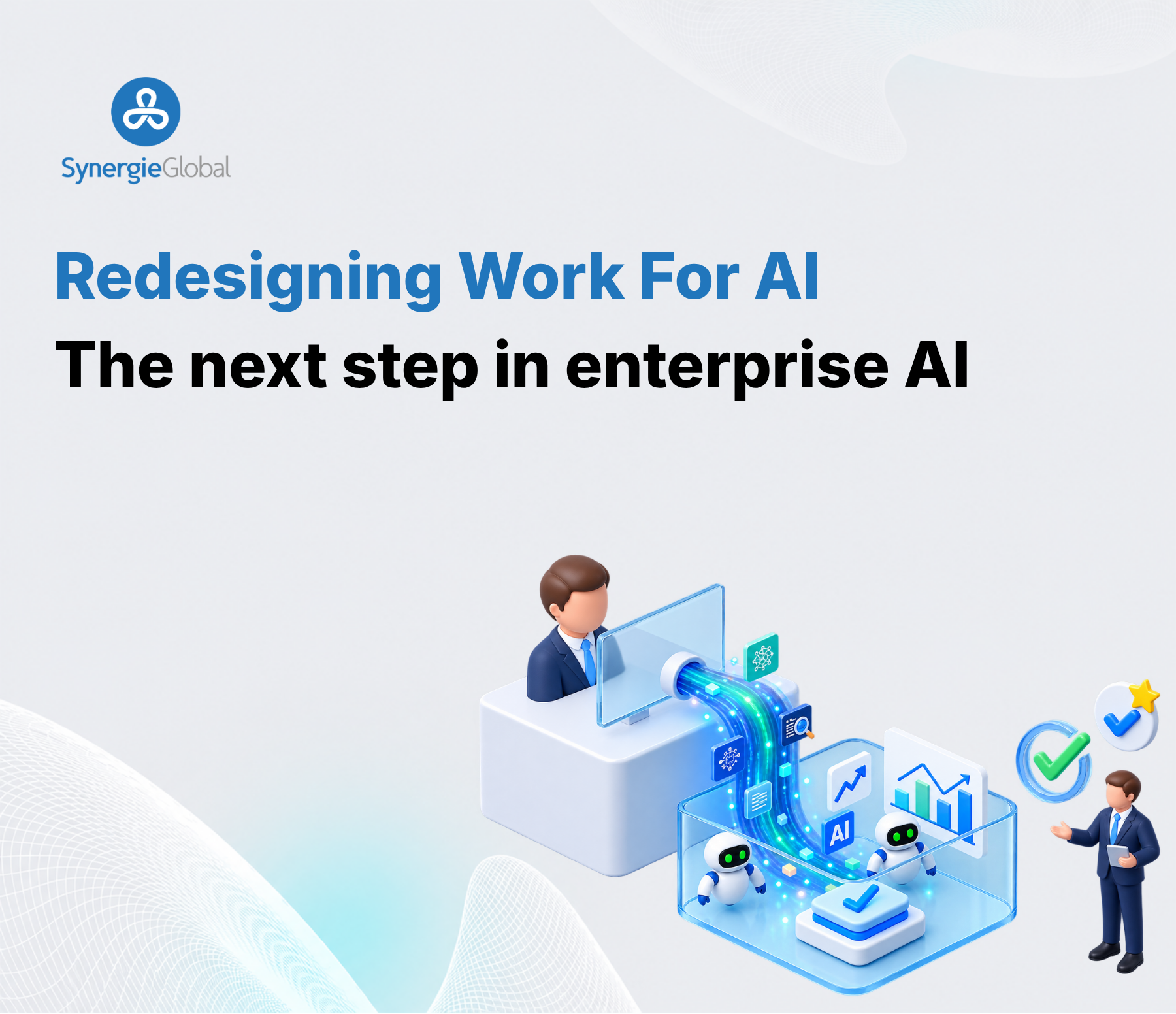
This is the idea behind AI Work Design: deliberately designing how humans and AI perform work together, rather than simply inserting AI into processes that were originally designed for people.
That starts with understanding the work itself.
Before deciding what to automate, organizations need to break a process down into its actual components: the tasks, decisions, dependencies, exceptions, and outcomes that make up the work.
Only then can leaders determine what should remain with people, what AI can perform, and where the two should work together.
This distinction matters.
AI may be capable of completing a task, but that doesn’t automatically mean it should own it.
Some work depends on judgment, context, relationships, or accountability. Other work may benefit from AI’s ability to process information, monitor workflows, or execute repetitive activities at scale.
The goal isn’t to give AI as much work as possible.
It’s to give each capability the right work.
Once that division is clear, the workflow itself can be redesigned.
Instead of simply adding an AI step to an existing process, leaders can reconsider the sequence of work, the handoffs between people and systems, where decisions happen, and when human intervention is necessary.
That also changes how the work needs to be governed.
If an AI capability is responsible for part of a workflow, someone still needs to own the outcome.
Leaders need to define what AI can do independently, when work should return to a person, how exceptions are handled, and who is responsible for improving the process over time.
Without that clarity, organizations may automate activity without actually improving the work.
The final step is measurement.
AI usage isn’t the same as business value.
The important questions are whether the workflow became faster, whether unnecessary handoffs were reduced, whether people can spend more time on higher-value work, and whether the business outcome actually improved.
This is why AI Work Design is becoming an important organizational capability.
The next stage of enterprise AI isn’t simply about finding more tasks for AI to perform.
It’s about understanding the work, redesigning it around human and AI capabilities, and continuously improving how those capabilities work together.
The question is no longer just: “How can we add AI to the way work is done? ”
It’s: “How should the work be designed when AI is part of the team?”
The organizations that learn to answer that question will be better positioned to turn AI from a technology investment into a new way of working.