

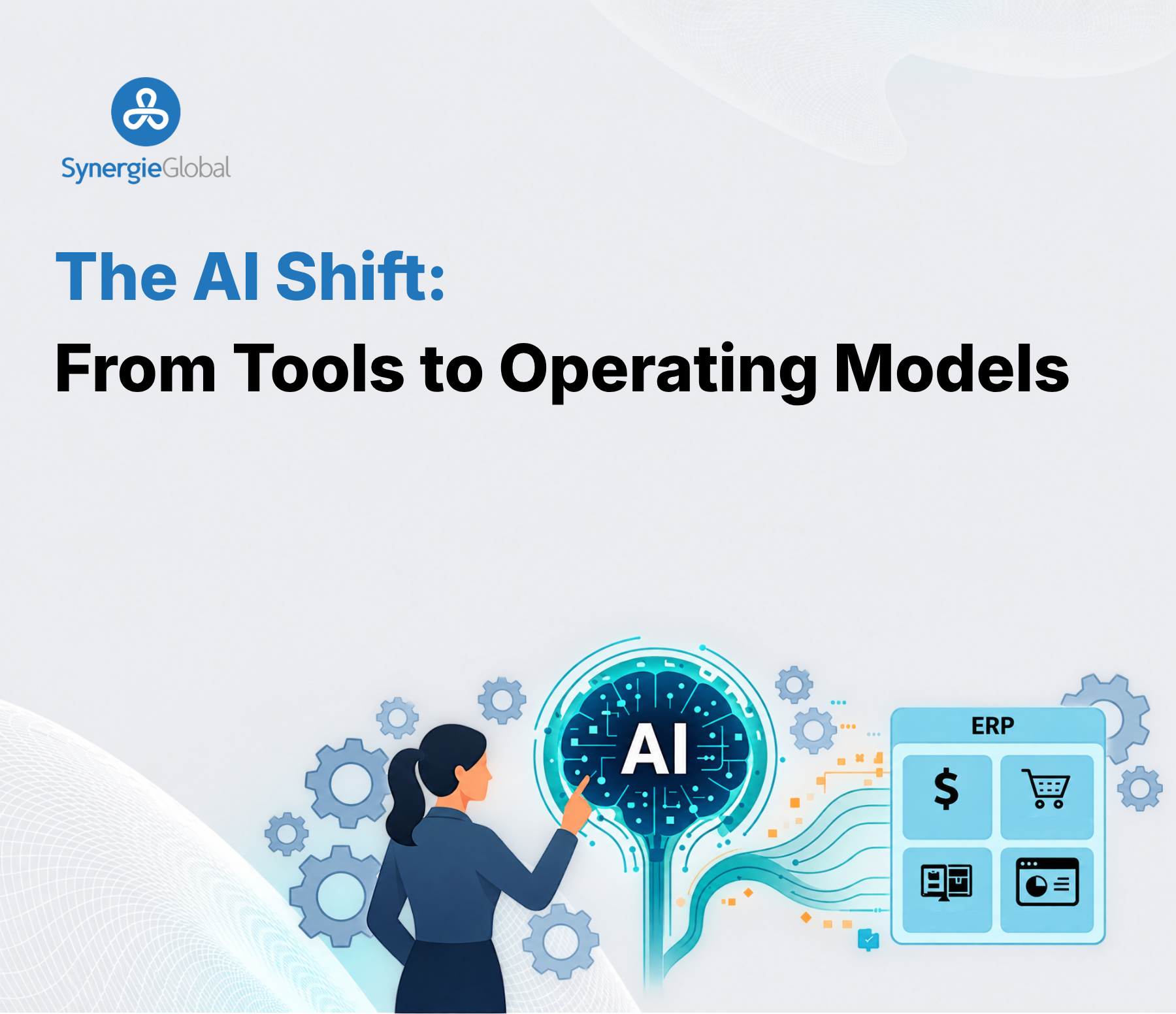
For years, enterprise AI has been treated as a technology problem.
Which model should we use?
Which platform should we buy?
Where can we deploy an AI agent?
Those questions still matter. But they are no longer the most important ones.
The next phase of enterprise AI is an operating-model problem.
That is where the ERP analogy becomes useful.
ERP Taught Enterprises That Software Alone Doesn’t Transform a Business
ERP systems changed how enterprises operated by connecting systems, standardizing processes, and creating a shared foundation for business operations.
But implementing the software was never the transformation itself.
Companies also had to rethink processes, responsibilities, data, governance, and how work moved across the organization.
AI is reaching a similar inflection point—but with a critical difference.
ERP primarily connected and standardized existing work.
AI can change who performs the work and how decisions get made.
Stop Adding AI to Old Workflows
One of the biggest mistakes enterprises can make is taking an existing workflow and simply inserting AI into it.
That may improve an individual task without changing the economics of the overall process.
Instead, CTOs and CIOs should ask:
“If we were designing this workflow today—with AI available from day one—what would we build differently?”
That question changes the conversation.
Instead of starting with a technology, start with a business outcome. Map the workflow end to end. Identify bottlenecks, repetitive decisions, unnecessary handoffs, and areas where human expertise is being consumed by low-value work.
Then determine where AI should assist, execute, or remain out of the process entirely.
The New AI Operating Model
An AI operating model brings together five things:
- Work: What activities should change?
- Decisions: What remains human-owned?
- Data: What information must be trusted and accessible?
- Technology: How should AI interact with existing systems?
- Governance: Who owns outcomes and exceptions?
This is where enterprise AI becomes more than another technology initiative.
The goal isn’t to deploy the most AI.
The goal is to redesign the right workflows around the capabilities AI makes possible.
The Real ERP Moment
AI doesn’t need to replace ERP to transform the enterprise.
The bigger opportunity is what happens around those systems: how people interact with them, how decisions move through the organization, and how work gets coordinated.
For CTOs and CIOs, the strategic question is no longer simply:
“Where should we deploy AI?”
It is:
“Where should we redesign the business because AI changes what is possible?”
The enterprises that answer that question first may gain an advantage that another AI tool alone cannot provide.