

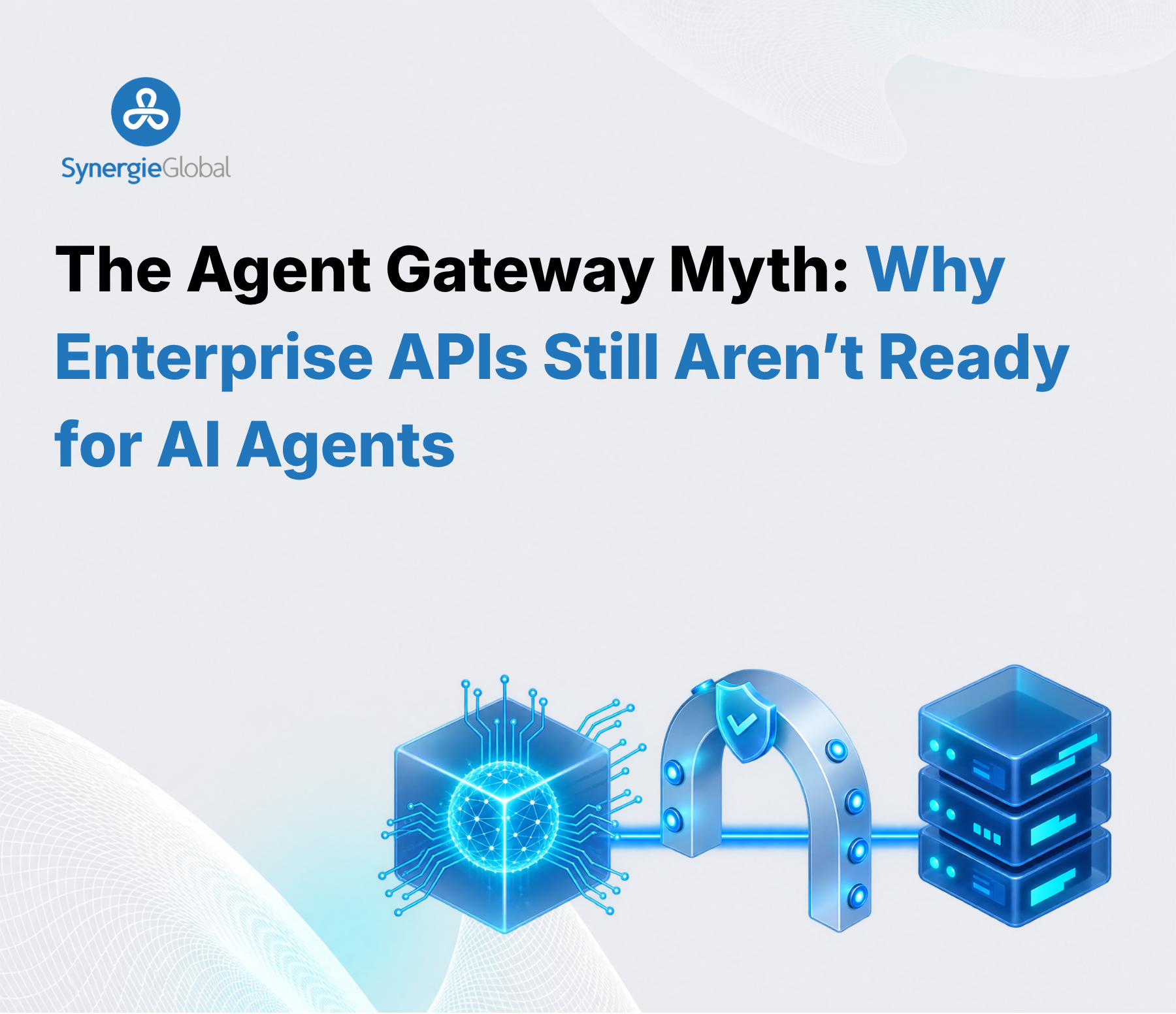
An agent gateway can help enterprises control how AI agents access their systems. But controlling access is not the same as making those systems ready for agents.
As organizations move from AI experimentation toward agentic workflows, the architectural challenge goes beyond connecting a model to an API. Agents need to discover available capabilities, understand what those capabilities do, execute tasks reliably, and operate within clearly defined boundaries.
Without these foundations, adding a gateway may improve control without solving the underlying readiness problem.
The Gateway Is Not the Whole Solution
Traditional enterprise APIs were often designed for known applications and predictable integrations. AI agents introduce a different interaction model: they may need to select tools dynamically, coordinate actions across systems, and respond to changing conditions.
That makes three capabilities essential.
1. Agent usability
Can an agent discover and understand what an API does, what inputs it requires, and what outputs to expect? Clear, structured API descriptions and meaningful business context help make capabilities understandable to both software and AI systems.
2. Reliable execution
Can the underlying operations handle failures, timeouts, invalid inputs, and unexpected responses? A successful API call does not guarantee a successful business workflow. Reliability requires error handling, validation, and recovery paths across the entire process.
3. Governed access
Can the agent access only the capabilities and data it needs? Permissions, execution limits, audit trails, and human approval for high-impact actions help keep autonomy within acceptable boundaries.
These requirements are connected, but none substitutes for the others.
What an Agent Gateway Can, and Cannot Solve
An agent gateway can provide a control point for managing access, enforcing policies, routing requests, and monitoring agent interactions.
It cannot automatically repair ambiguous API contracts, supply missing business context, or make unreliable operations dependable. Nor does exposing an API through a gateway guarantee that an agent can use it correctly.
The gateway is one layer of an agent-ready architecture, not the architecture itself.
A Prioritized Roadmap for CTOs
Rather than exposing every enterprise API to every agent, CTOs can take a workflow-first approach:
- Assess: Select one high-value business workflow and map the systems and capabilities it requires.
- Prepare: Identify gaps in API descriptions, business context, input validation, and error handling.
- Govern: Define permissions, execution boundaries, monitoring, and approval requirements before expanding autonomy.
- Validate: Test the complete workflow, including failures, exceptions, and recovery, not just individual API calls.
- Prioritize: Rank improvements by business value, operational risk, and implementation effort.
This approach turns agent readiness into a practical engineering roadmap rather than a broad platform initiative.
Readiness Before Scale
Enterprise AI adoption will not be determined by how many APIs an organization exposes to agents. It will depend on whether the right capabilities can be discovered, understood, executed reliably, and governed effectively.
For CTOs, the next step is not simply to add an agent gateway. It is to identify the workflows where agents could create meaningful value, and build the architectural foundations that let them operate safely and dependably.
Agent-ready architecture starts with usable, reliable, governed capabilities. The gateway helps enforce the boundaries; it cannot build those foundations alone.