

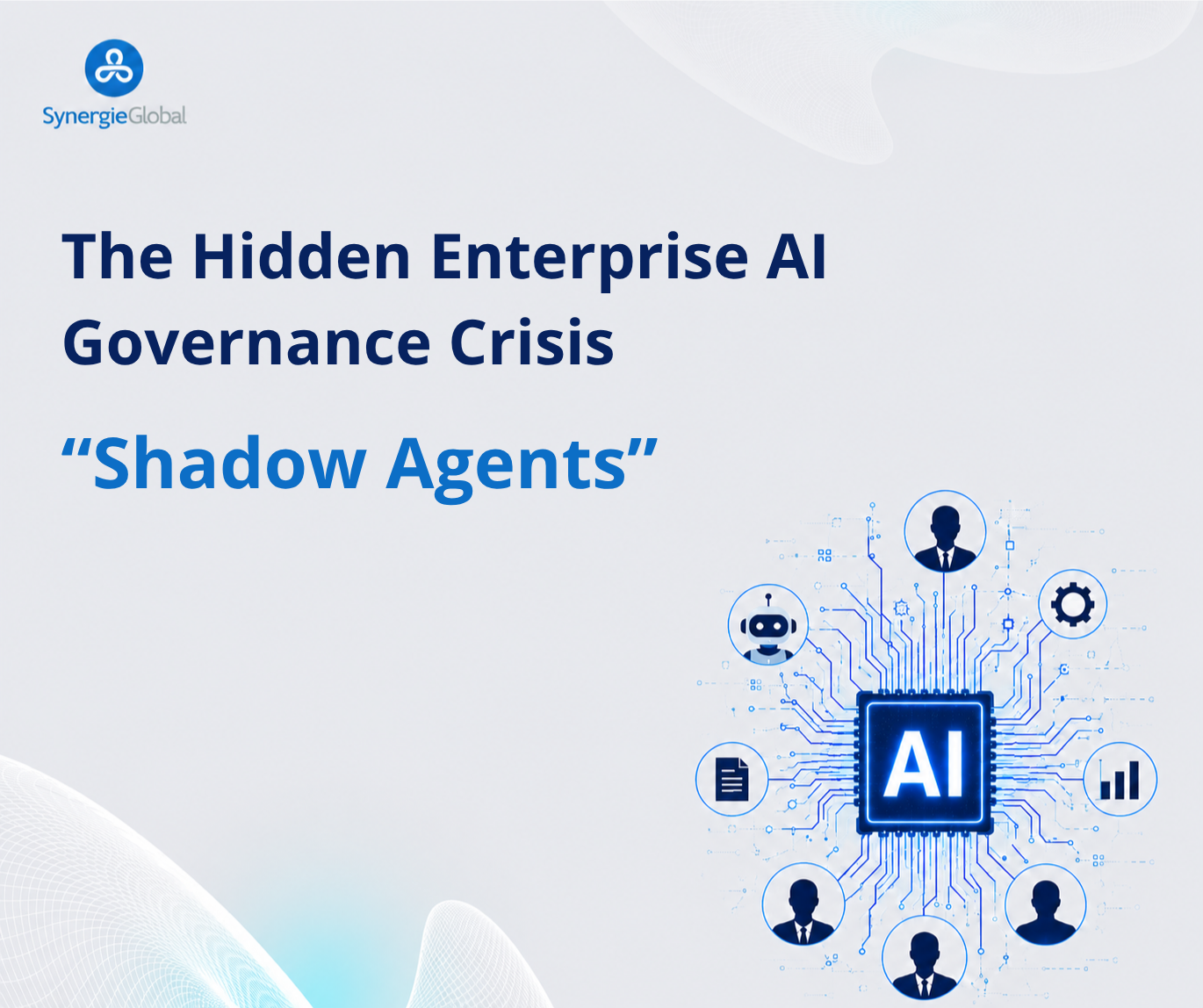
Most enterprises believe they are becoming AI-driven because they are adopting more AI tools. Across organizations, teams are deploying copilots, integrating LLM APIs, experimenting with AI agents, and automating workflows faster than ever before. On the surface, this appears to be progress toward digital transformation. However, beneath that momentum, a more serious issue is emerging.
Many enterprises are unintentionally building fragmented ecosystems of disconnected AI systems operating without centralized orchestration, governance, or operational visibility. These systems increasingly influence workflows, automate decisions, and interact with enterprise data independently across departments. As a result, organizations are entering the era of what can be described as “shadow agents” — AI systems operating outside coordinated oversight.
The core issue is that many organizations still approach AI adoption the same way they approached SaaS adoption over the last decade: teams independently acquire tools, workflows evolve separately, and governance becomes reactive. While this model may have worked for traditional software, AI fundamentally changes how technology operates inside the business.
Unlike conventional systems, AI directly impacts operational reasoning, workflow execution, institutional knowledge access, and decision-making itself. AI is no longer just another productivity layer — it is becoming part of the enterprise’s operational infrastructure. And infrastructure requires coordination.
This is why AI failure at scale is not primarily a model problem — it is an orchestration and governance problem.
Most organizations are not struggling because AI models are weak. They are struggling because intelligence is becoming fragmented across systems, workflows, and departments without centralized coordination. Different teams deploy different AI tools, governance standards become inconsistent, enterprise context becomes fragmented, and visibility into how intelligence flows through the organization begins to disappear.
This creates one of the most dangerous misconceptions in enterprise AI today: the belief that adopting more AI tools automatically creates AI capability.
It does not.
Two organizations can deploy the exact same AI model and achieve completely different business outcomes. The difference rarely comes from the model itself. It comes from how intelligence is coordinated across the organization — who owns orchestration logic, how governance is enforced, and how workflows integrate across enterprise systems.
The enterprises that succeed with AI will not necessarily have the most tools. They will have the clearest AI operating model — one built around orchestration, governance, workflow intelligence, and enterprise-wide coordination. Because while AI models will continue to commoditize, operational coordination will become the real competitive advantage.