

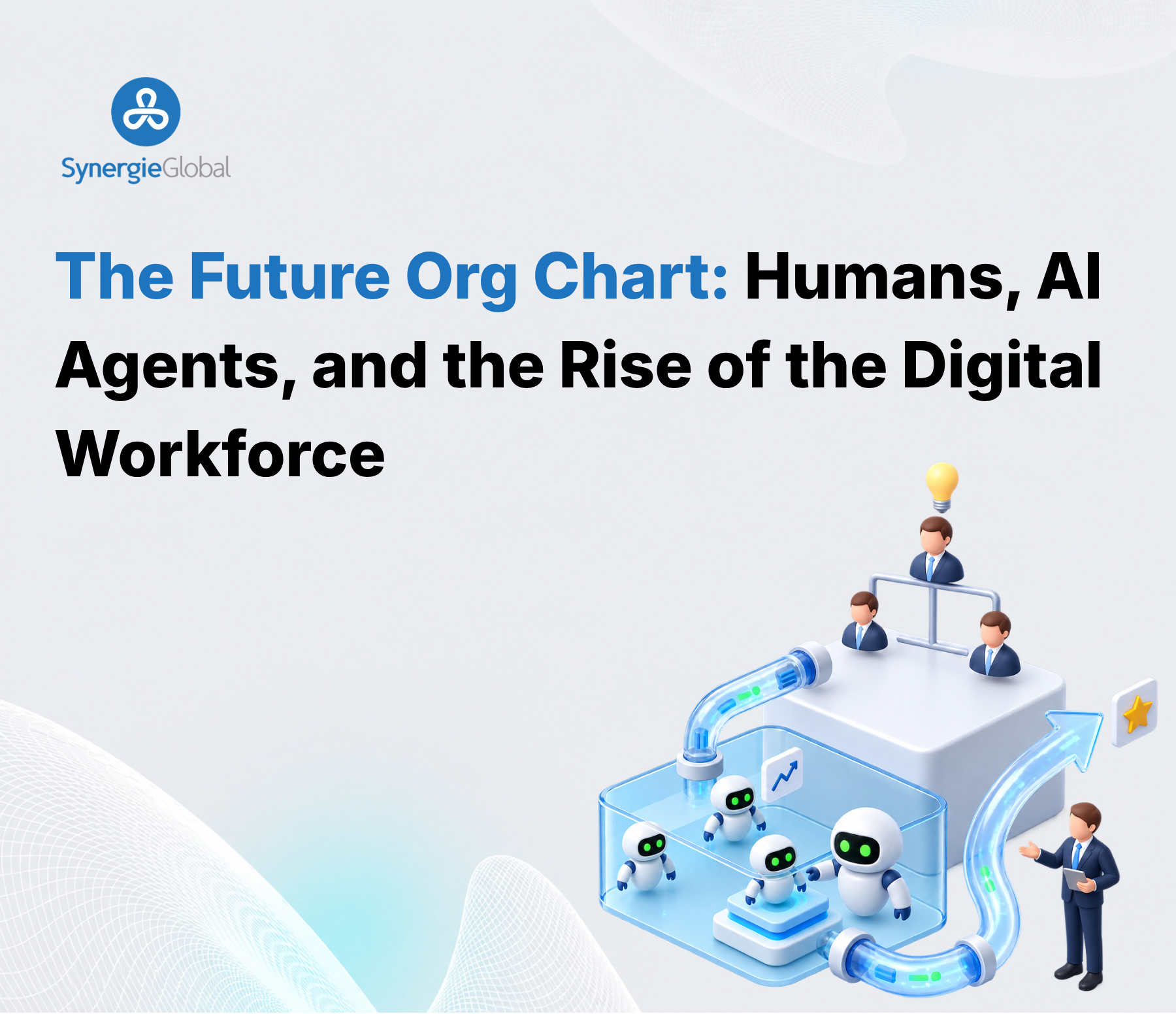
For decades, the enterprise org chart has been built around one basic assumption:
The people doing the work are human.
That assumption is beginning to change.
Organizations are starting to create roles dedicated to identifying, designing, deploying, and managing AI-driven workflows. At the same time, AI agents are becoming capable of taking on defined responsibilities within those workflows.
This doesn’t mean AI agents become employees in the traditional sense. It means organizations are gaining access to a new kind of capability, one that can be designed into teams alongside human expertise.
That creates a different question for enterprise leaders.
It’s no longer simply: “Where can we use AI?”
It’s: “What could our teams accomplish if human and digital capabilities were designed to work together?”
Consider a customer operations team. Humans may remain responsible for customer relationships, complex decisions, and situations that require judgment and context. Digital capabilities can support defined parts of the workflow, helping handle repeatable processes and keeping work moving.
The team hasn’t become less human.
It has become more capable.
This is where the idea of a digital workforce becomes important.
The value isn’t necessarily in replacing an existing role. It’s in creating capabilities that don’t need to exist as traditional human positions.
A digital capability can support a team without requiring another person to manage every repetitive step of a process. It can extend the capacity of existing specialists, reduce operational workload, and allow people to spend more time on the work where human judgment creates the most value.
But adding these capabilities also creates a new management challenge. If an AI agent has a defined responsibility, someone needs to own that responsibility.
Who determines what it can do?
Who decides when it needs human intervention?
Who is accountable when something goes wrong?
And how do you know whether the capability is actually improving the business?
These questions are familiar in human organizations, but they become increasingly important when digital capabilities become part of how work gets done. This is where the traditional org chart starts to become less useful. Historically, organizational structures have been built around people, roles, departments, and reporting lines.
An AI-native organization may need to think in terms of something broader:
People + digital capabilities → teams → workflows → outcomes.
The org chart may no longer be only about who reports to whom.
It may also need to show what capabilities a team has, who owns them, and how they contribute to an outcome.
That doesn’t mean organizations need to redraw their org charts tomorrow. It means leaders need to start thinking differently about workforce design.
Instead of asking only how many people a team needs, they can begin asking what capabilities the team needs, and which are best delivered through human expertise, digital capabilities, or a combination of both.
The organizations that get this right won’t simply deploy more AI.
They’ll build teams that can do more because of it.
The future of organizational design isn’t about choosing between humans and AI.
It’s about designing the right combination of both.