

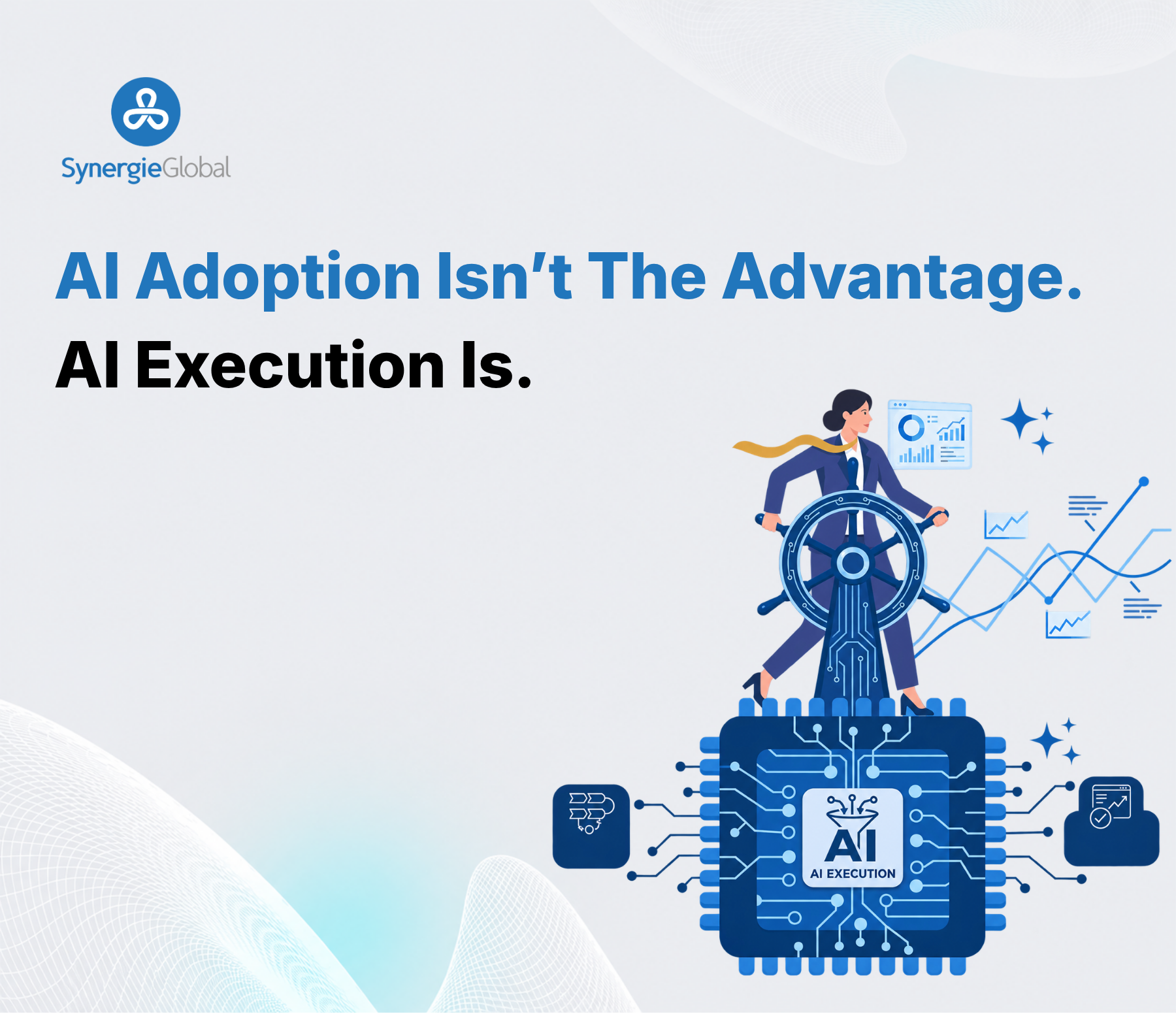
For the past few years, the enterprise AI question has been:
“Are you using AI?”
That question is becoming less useful.
As access to capable AI becomes more widespread, having AI tools, running pilots, or experimenting with new use cases will become less differentiating.
The more important question is:
“Can your organization actually execute with AI?”
This is where the next digital divide is beginning to emerge.
It won’t necessarily separate companies that have AI from companies that don’t.
It will separate organizations that can move AI from experimentation into everyday operations from those that remain stuck in pilots.
The First Divide Was Access. The Next Is Execution.
Previous technology shifts created competitive gaps around access.
Organizations that adopted digital infrastructure, cloud systems, and data capabilities earlier could build advantages while others were still catching up.
AI is different.
The underlying technology is becoming increasingly accessible.
Two companies can have access to similar models, tools, and capabilities while getting very different results.
The difference isn’t necessarily the technology.
It’s what the organization can do with it.
A successful AI pilot can prove that something is technically possible.
But proving that an AI capability works is very different from making it work reliably inside the business.
That requires workflows, data, governance, ownership, integration, and a way to measure whether the capability is actually creating value.
Why AI Experiments Get Stuck
An AI experiment can live inside a controlled environment.
Production cannot.
Once an AI capability becomes part of a real business process, it has to interact with existing systems, people, data, decisions, and exceptions.
The questions become harder.
Where does the data come from?
Who owns the workflow?
What happens when the AI encounters an exception?
Which systems does it need to access?
Who is accountable for the outcome?
How do you know whether the process actually improved?
This is why moving from an AI pilot to an operational capability requires more than a working model.
The organization around AI has to work too.
AI Execution Is Becoming an Organizational Capability
AI execution is the ability to move AI from experimentation into repeatable, governed, measurable business operations.
That requires several capabilities working together.
Integration connects AI to the workflows and systems where work actually happens.
Governance establishes how AI should operate, what it can do, and where human judgment remains necessary.
Orchestration allows AI capabilities, systems, and teams to work together across business processes.
Adaptation changes processes and responsibilities when new capabilities change how work gets done.
Measurement determines whether those changes are producing meaningful business outcomes.
None of these capabilities exist inside the AI model itself.
They exist in the operating environment around it.
From Experimentation to Execution
The shift can be understood through four stages:
Experiment.
Identify where AI can create meaningful value and prove the use case.
Operationalize.
Connect the capability to real workflows, systems, data, ownership, and governance.
Scale.
Extend what works beyond an isolated team or use case and make it repeatable across the organization.
Measure.
Evaluate the business outcome—not simply whether people are using the technology.
This changes what it means to be an AI-ready organization.
It isn’t the organization with the most pilots.
It’s the organization that can repeatedly turn successful experiments into operating capabilities.
Stop Measuring AI Activity. Start Measuring AI Execution.
Organizations can easily measure activity:
How many AI tools have been deployed?
How many employees are using them?
How many pilots are running?
How many use cases have been identified?
These numbers can show momentum.
But they don’t necessarily show execution.
A more useful scorecard asks:
How many AI capabilities have reached production?
How deeply are they integrated into business workflows?
How consistently are they being used?
What measurable outcomes have they produced?
How quickly can successful use cases be scaled?
The shift is subtle but important.
From measuring AI activity to measuring AI capability.
The New Digital Divide
The next divide won’t simply be between organizations using AI and organizations that aren’t.
It will increasingly be between experimenters and operators.
Experimenters will continue accumulating pilots, tools, and proofs of concept.
Operators will build the systems, processes, governance, and organizational capabilities needed to turn AI into repeatable business value.
Both may have access to similar technology.
But they won’t have the same ability to execute.
And as AI becomes more accessible, that difference will matter more—not less.
The competitive advantage won’t come from simply having AI.
It will come from knowing how to make AI work across the business.
The next stage of enterprise AI isn’t about adoption.
It’s about execution.