

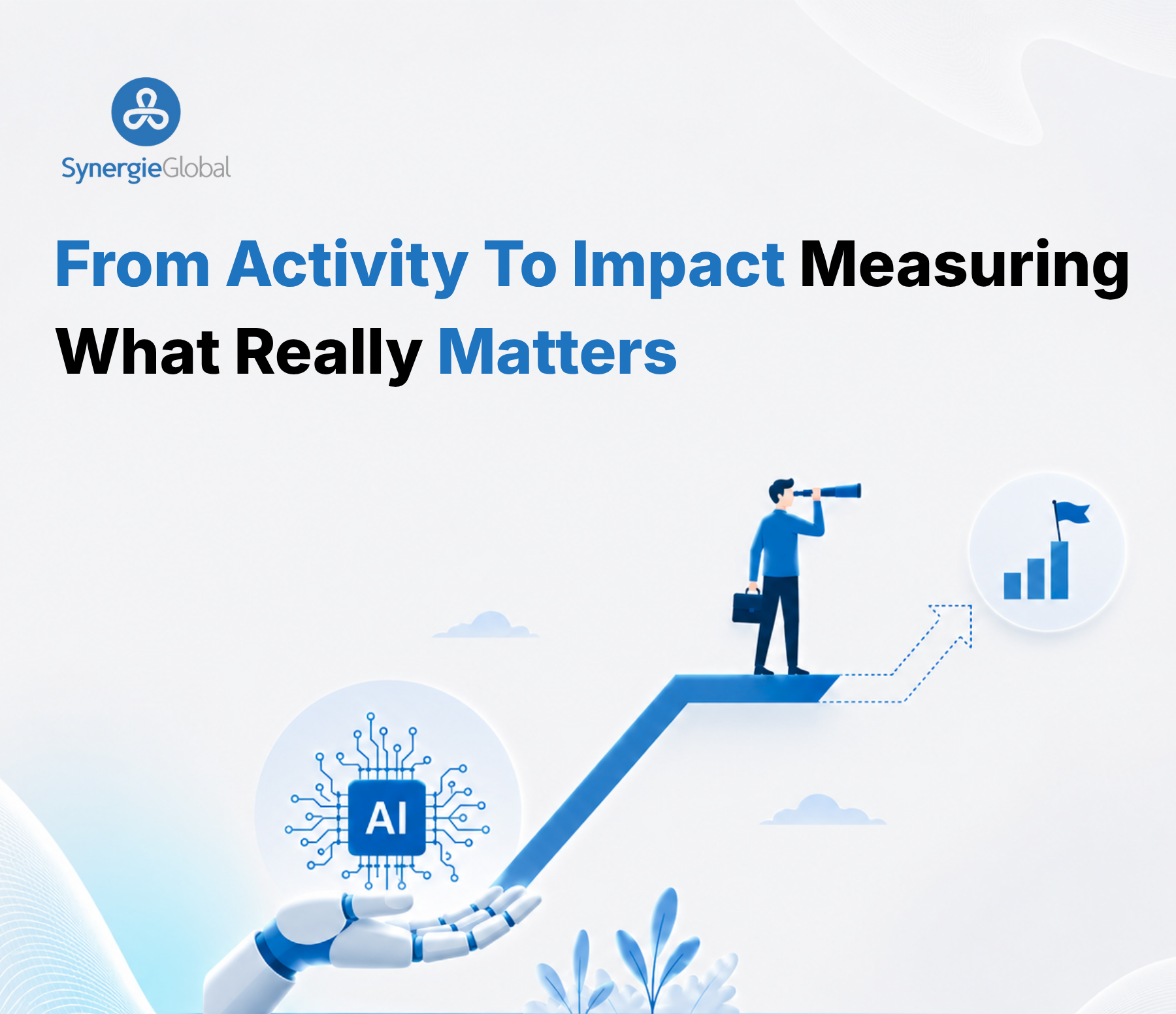
Every successful AI project seems to begin with the same headline:
“We saved hundreds of hours.”
While impressive, it’s only half the story.
Hours saved don’t automatically translate into happier customers, faster growth, or stronger financial performance. Yet productivity remains one of the most common ways organizations measure AI success.
That’s where many AI strategies begin to drift.
The Productivity Trap
AI is exceptionally good at helping people complete tasks faster. It can summarize documents, automate repetitive work, and accelerate decision-making.
But faster work isn’t the goal.
Business outcomes are.
An inefficient process completed twice as fast is still an inefficient process. Likewise, automating low-impact tasks may improve productivity without creating meaningful value for the business.
Productivity is an output.
Business performance is the outcome.
The Questions Leaders Should Be Asking
Instead of asking, “How much time did AI save?”, executives should ask:
- Did customers receive faster or better service?
- Did decision-making improve?
- Did operational bottlenecks decrease?
- Did AI help the business generate more value?
These questions shift the conversation from activity to impact.
Because AI isn’t valuable simply because it’s busy, it’s valuable when it improves how the business performs.
Why the Difference Matters
Organizations often celebrate early productivity gains because they’re easy to measure.
Business value takes longer to appear.
It requires AI to be integrated into the right workflows, supported by the right operating model, and aligned with meaningful business objectives.
Without that connection, organizations risk optimizing for efficiency while overlooking whether AI is moving the business forward.
A Better Way to Think About AI Success
As AI adoption matures, the conversation should evolve with it.
The question is no longer: “How much faster are our teams working?”
It’s: “What business outcome improved because of AI?”
That shift changes how organizations prioritize AI investments, evaluate success, and scale initiatives across the enterprise.
Because in the end, businesses don’t compete on productivity alone.
They compete on the value they create.
The organizations that recognize the difference will be better positioned to turn AI activity into lasting business outcomes.