

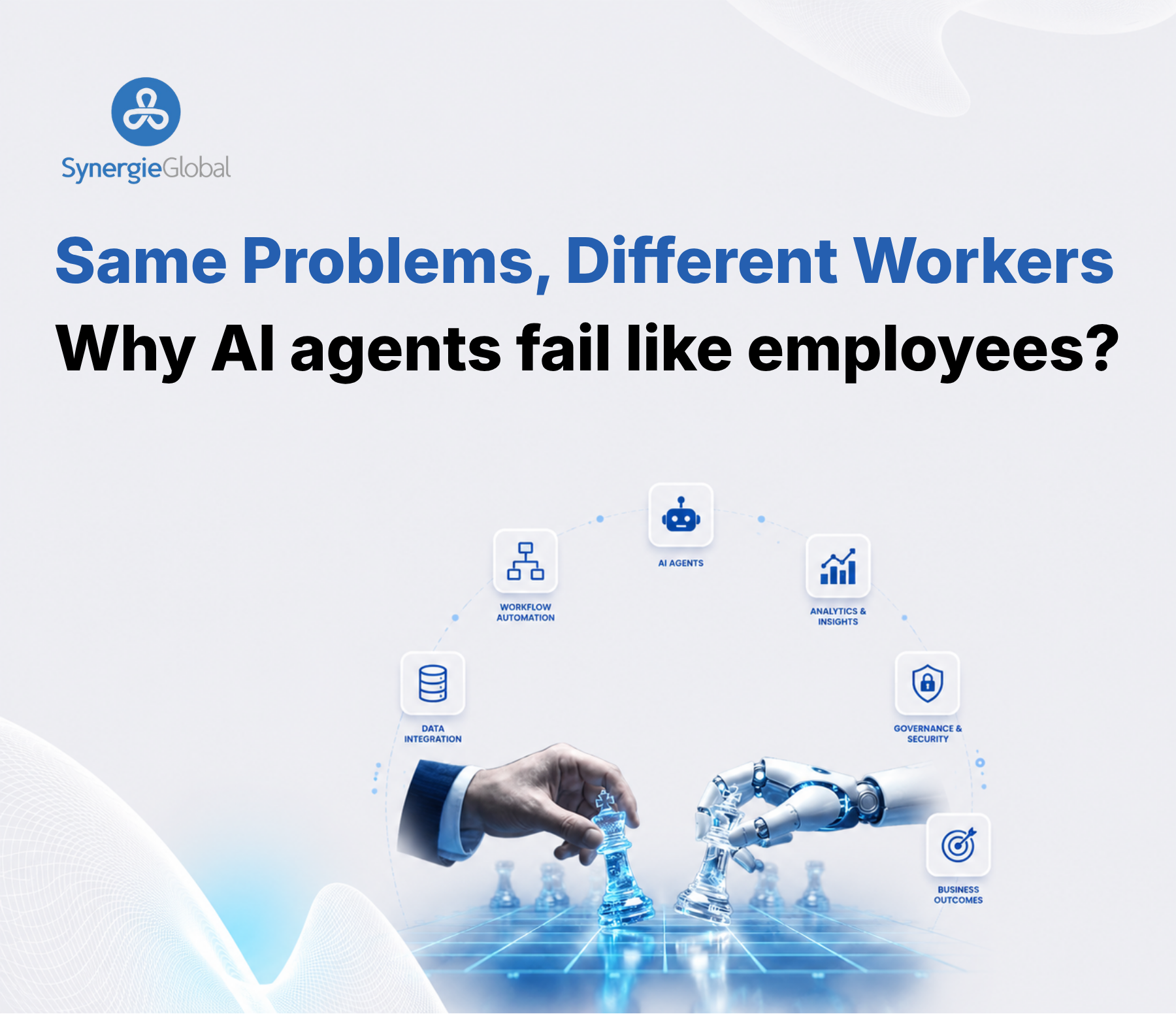
Most organizations expect AI agents to eliminate human error.
Yet many AI deployments fail for surprisingly familiar reasons.
Not because the technology isn’t capable. Not because the model isn’t intelligent enough.
But because the environment around it is poorly designed.
The same factors that cause employees to struggle often cause AI agents to fail.
Unclear Responsibilities
Employees perform poorly when expectations are vague.
AI agents are no different.
When objectives, decision boundaries, and success criteria are unclear, outcomes become inconsistent. Organizations often blame the technology when the real issue is a lack of operational clarity.
Missing Context
Even the most capable employee cannot make good decisions without access to the right information.
AI agents depend on context too.
Without access to relevant business data, workflow history, or organizational rules, agents are forced to operate with incomplete information. The result is predictable: poor decisions and unreliable outputs.
Poor Training
Organizations invest heavily in onboarding employees.
Yet many AI agents are deployed with fragmented knowledge sources, incomplete instructions, or poorly designed workflows.
The expectation is enterprise-grade performance. The reality is often confusion at scale.
No Escalation Path
Good employees know when to ask for help.
Many AI systems do not.
When an agent encounters uncertainty, ambiguity, or exceptions, there must be a clear path for human intervention. Without one, small issues can quickly become operational risks.
No Performance Management
Employees receive feedback, coaching, and performance reviews.
AI agents require the same discipline.
Deployment is not the finish line. Organizations need visibility into how agents perform, where they fail, and how they improve over time. Without monitoring and oversight, performance inevitably degrades.
The Real Lesson
Organizations often treat AI agents as software products.
The organizations succeeding with agentic AI increasingly treat them as workforce members.
Not because agents are human.
But because intelligence alone is rarely the reason employees succeed.
Management is.
As AI becomes a larger part of enterprise operations, the question is no longer whether organizations can deploy AI agents.
The question is whether they can manage them effectively.